6 Dec 2025


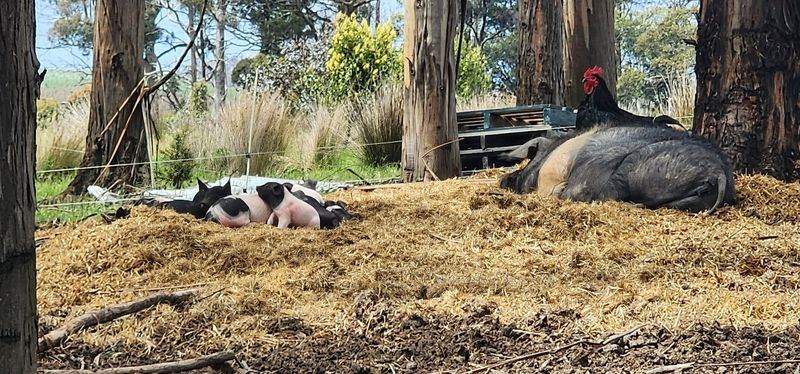
Barry the Rooster visiting the pigs
Our caption said it best: "Barry the Rooster visiting the pigs."
Pastured heritage pork
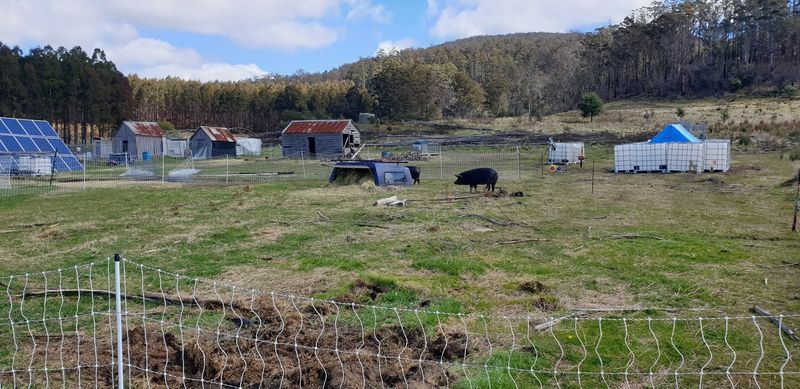
Our pigs live outdoors on pasture, with shade, shelter and straw, room to root and wallow, and a fresh paddock every one to three weeks.


Our pigs are Wessex Saddlebacks, a heritage breed you'll know by the white band over their black shoulders.


Our girls are grown out longer for bacon and ham, and our boys go younger for pork cuts and sausages, because we don't castrate and this avoids boar taint. See end of life.
We're bringing a tired old dairy farm on Tower Hill back as a working regenerative farm. We've planted about 80,000 native trees and shrubs in our carbon project, and we're planting about 20,000 more for the bees and fodder that aren't part of the carbon project. The carbon planting covers about half the farm, on a 6 x 6 metre grid, with the trees planted a little closer along the rows to allow for losses (see our carbon project).
Our bacon, hams and kranskies are made from our own pigs.


By free-range we mean born and raised outdoors, never housed indoors.


We don't castrate, so males are processed at 4 to 5 months for pork cuts and sausages, and females at 8 to 9 months for bacon, ham and smallgoods.
About a week before processing, we set up a portable yard in the pigs' own paddock and feed them there, so it becomes familiar. When the day comes, William loads them himself and drives them carefully to Legerwood Abattoir, keeping stress to a minimum.
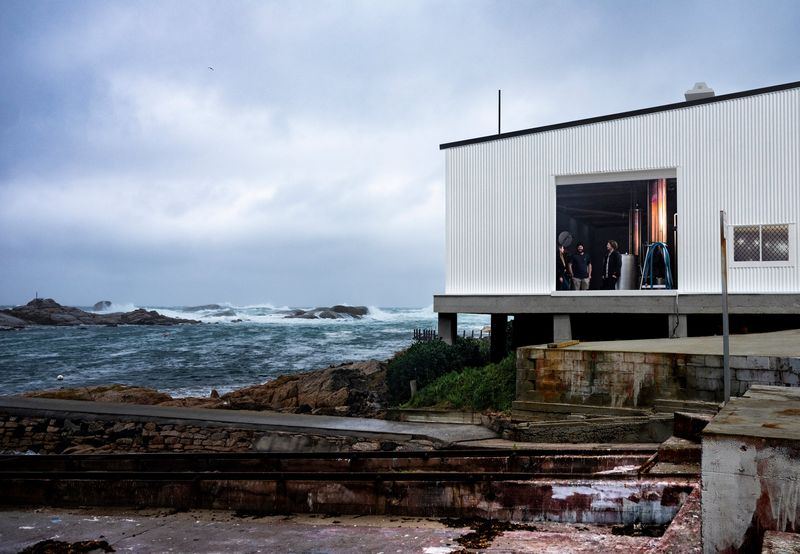
Every week we head over to Waubs Harbour Distillery (opens in a new tab) in Bicheno and collect their spent Tasmanian barley and yeast. Back at the farm we mix it with a custom concentrate with all soy products removed. It gives the pigs the minerals and nutrition they need for steady, healthy growth on pasture. Then we feed it to them out in the paddocks.

Our pigs get that feed once a day. The rest of the time they're out foraging for themselves: digging for grubs and roots, munching weeds and grass, and chasing bugs. Basically doing what pigs do naturally!


We move the pigs onto fresh pasture about every 2 weeks. It can be anywhere from 1 to 3 weeks, depending on how many pigs there are, how big they are and how the ground is holding up. The pigs' rooting does a lot of the weed clearing a tractor would otherwise do. Then we come in behind them and broadcast pasture seed mixes to bring the paddock back. The mix changes with the time of year, and the aim is to get a wide range of pasture species growing.


Waubs Harbour Distillery has its own cooperage. Their barrels hold whisky for multiple years, and before a barrel is filled again, it's shaved back to virgin wood and recharred. We get those shavings from the inside of the barrel, and that's what we smoke our bacon, ham and kranskies with. Delicious smoked flavour, and a proper local loop.
From Waubs to the pigs and back to the smokehouse, it all goes round in a circle.

Waubs Harbour Whisky sits on the ocean at Bicheno. They make whisky on the old oyster hatchery site, and they run their own cooperage, so the barrels that hold their whisky for multiple years are worked and reworked right there.
When a barrel is ready to be refilled, it is shaved back to virgin wood and recharred. Those oak shavings are what we use to double smoke our Christmas hams, bacon and kranskies. So every smoked pack on our counter carries a bit of Bicheno cooperage with it.
We don't promise smoked meat every week of the year. When our pigs and the smokehouse line up, you'll find it at the Fingal Post Office and on the Christmas ham page.
Spent barley and yeast from Waubs also feed our pigs, so the loop runs both ways: grain to whisky, leftovers to the paddock, and barrel wood back into the smoke.
Over Bicheno way? See tours, tastings and more from Waubs.
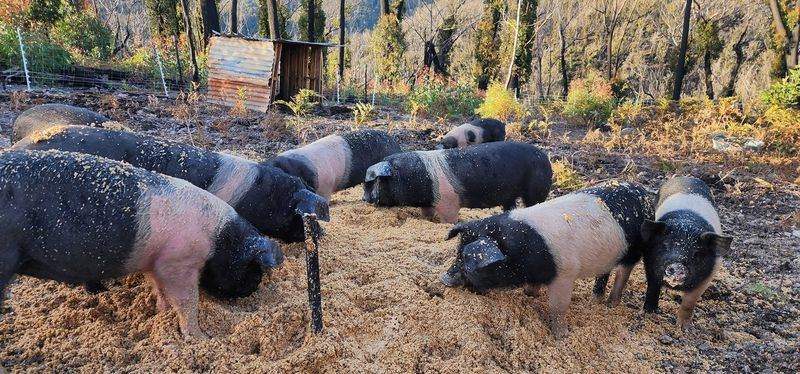

6 Dec 2025
Our caption said it best: "Barry the Rooster visiting the pigs."
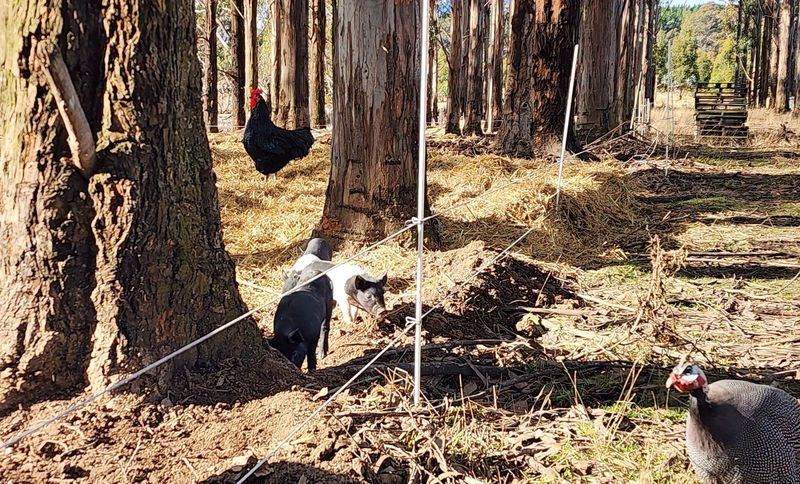
27 Jun 2026
"Our rooster Barry has taken on the job of piglet babysitting. We caught him sitting on piglets a couple days ago keeping them warm like a mother hen would her chicks 😁"
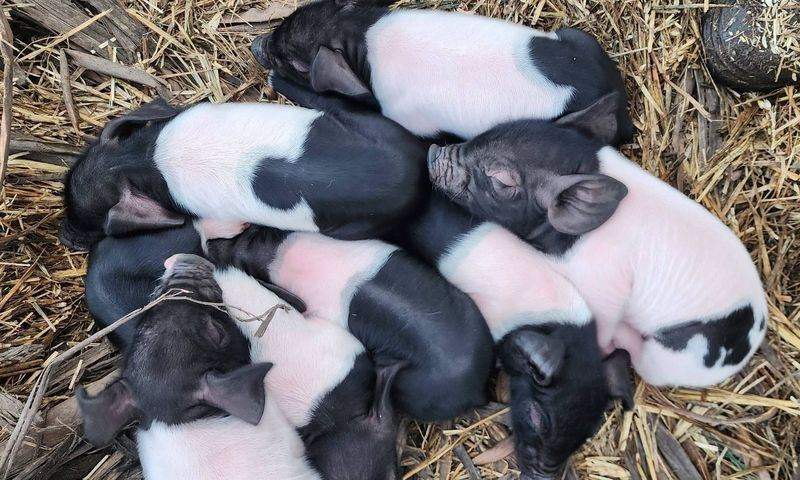
7 Jul 2026
Winter is litter time on the farm. Here's what we posted:
"Our 'bacon seeds' are late this year: 3 of 8 litters are here, 21 piglets so far.
We're going through a lot of straw bales keeping everyone warm this winter.
Glad we're past solstice, looking forward to longer days..."
Buy at the Fingal Post Office, or register your interest for the next batch.
Fresh and smoked meat (pork, ham, bacon, beef, goat and lamb) is GST-free.
Taking interest only
Planning a spit roast, a hangi or a big get-together? Every now and then we have a suckling pig or a whole pig to spare. They're Wessex Saddleback heritage pigs, raised outdoors on pasture here at Tower Hill.
Our suckling pigs are usually cryovac-packed and frozen. Sometimes there's one in the freezers at the Fingal Post Office, or you can ask for one by special order. $25 per kg (GST-free). We can't promise there'll always be one in stock, so register your interest and we'll be in touch when one's available.
For a side, or a whole pig for a spit roast or hangi, a deposit is required to secure your order. These are usually collected directly from the meatworks/butcher, and we'll confirm the details with you when one's ready.
Or join the meat mailing list to hear about new batches.