Tasmania's first payable gold was found just below us. Prospecting on the farm is coming. Here's what you need to know.
Try your luck in gold country
Our farm sits in the hills above Mangana, where Tasmania's gold story began. Prospecting on our farm isn't open to guests yet. Minerals belong to the Crown, so even with our permission you'd need your own Prospecting Licence. We'll update this page if that changes. Ask us about prospecting
The rules in Tasmania
Prospecting Licence. Tasmania uses a Prospecting Licence, issued by Mineral Resources Tasmania (MRT). It lets you look for minerals by hand, to less than 2 m deep, for recreational or educational purposes only. It runs for 5 years and costs about $39 a year. Check the current fee and apply with Service Tasmania.
Age. Anyone over 18 can apply. Under 18s can only prospect with an adult who holds a licence and supervises them.
Fossicking areas. You don't need a licence to fossick inside MRT's declared fossicking areas. The closest to us are Weld River and Gladstone Hill in the north-east, known for gemstones and tin rather than gold. Check MRT's current conditions for which tools and detectors are allowed in fossicking areas. Metal detecting isn't allowed in national parks and reserves. Fossicking anywhere else needs a licence.
Metal detecting. Check MRT's current conditions for which tools and detectors are allowed in fossicking areas. Metal detecting isn't allowed in national parks and reserves.
Gold panning. Panning counts as hand prospecting, so it needs a licence outside fossicking areas. Hand-held, unpowered sluices and high-bankers under 1 m long are fine. Dredges, trommels, motorised pumps and explosives are banned.
Leave it as you found it. Fill every hole. Don't dig or undermine creek banks, roadside gutters or embankments, don't cut tracks, and don't disturb Aboriginal or historic sites and relics, including old mining relics. Disturbing an Aboriginal relic is an offence under the Aboriginal Heritage Act 1975 (Tas). If you find one, leave it where it is and report it to Aboriginal Heritage Tasmania (1300 487 045).
Check before you go. MRT's Prospecting Access Map Viewer shows land tenure and where prospecting is allowed. Mining leases and exploration licences need the tenement holder's permission too.
On our land
Prospecting on our farm isn't open to guests yet. Minerals belong to the Crown, so even with our permission you'd need your own Prospecting Licence. We'll update this page if that changes.
There's Crown land and state forest around Tower Hill, Mathinna and Fingal, but not all of it is open to prospecting. Much of the district is covered by exploration licences, so always check the exact spot before you go.
Where you can go, with a licence
Crown land with no mineral tenement over it. A Prospecting Licence lets you prospect on Crown land that isn't under a mining lease or exploration licence. Not all Crown land is open, so check the MRT Prospecting Access Map Viewer first.
State forest. Much of the forest around us is managed by Sustainable Timber Tasmania (STT). Use existing tracks, leave gates as you find them, and only take registered vehicles with licensed drivers. Areas can close for harvesting or burns. If you're unsure whether you need notice or approval, check with STT before you go.
Declared fossicking areas. No licence is needed. Check MRT's current conditions for which tools and detectors are allowed in fossicking areas. Metal detecting isn't allowed in national parks and reserves. The nearest are Weld River, near Moorina (about 38 km from Mathinna, about 56 km from Fingal), known for sapphire, spinel and tin, and Gladstone Hill, near Gladstone (about 57 km from Mathinna, about 75 km from Fingal), known for smoky quartz and topaz. Neither is a gold site. Distances are about, in a straight line, and the drive is longer.
Where you can't
National parks and other reserves. Don't assume any reserve is open. Metal detecting isn't allowed in national parks and reserves, and you can't dig or take rock or minerals there. If the map shows reserve land, treat it as off limits.
Mining leases and exploration licences, without consent. You need the tenement holder's written consent first, and on private land under a tenement, the landowner's too. If the tenement is still an application, the Director of Mines must also approve.
Private land without the owner's permission.
The licence you need
A Prospecting Licence from Mineral Resources Tasmania covers hand-held tools only, less than 2 m deep, for recreational or educational use. It runs for 5 years and costs about $39 a year, so check the current fee when you apply. You must be 18 or over to apply. Under 18s can prospect only with a licensed adult.
Useful links
Official pages only. Rules change, so check them before every trip.
Gold in Tasmania began here. In February 1852 the island's first payable gold was found at a place then called the Nook, on Richardsons Creek, now Mangana. The find drew diggers into the Fingal Valley and helped open up the northern end of the valley to mining.
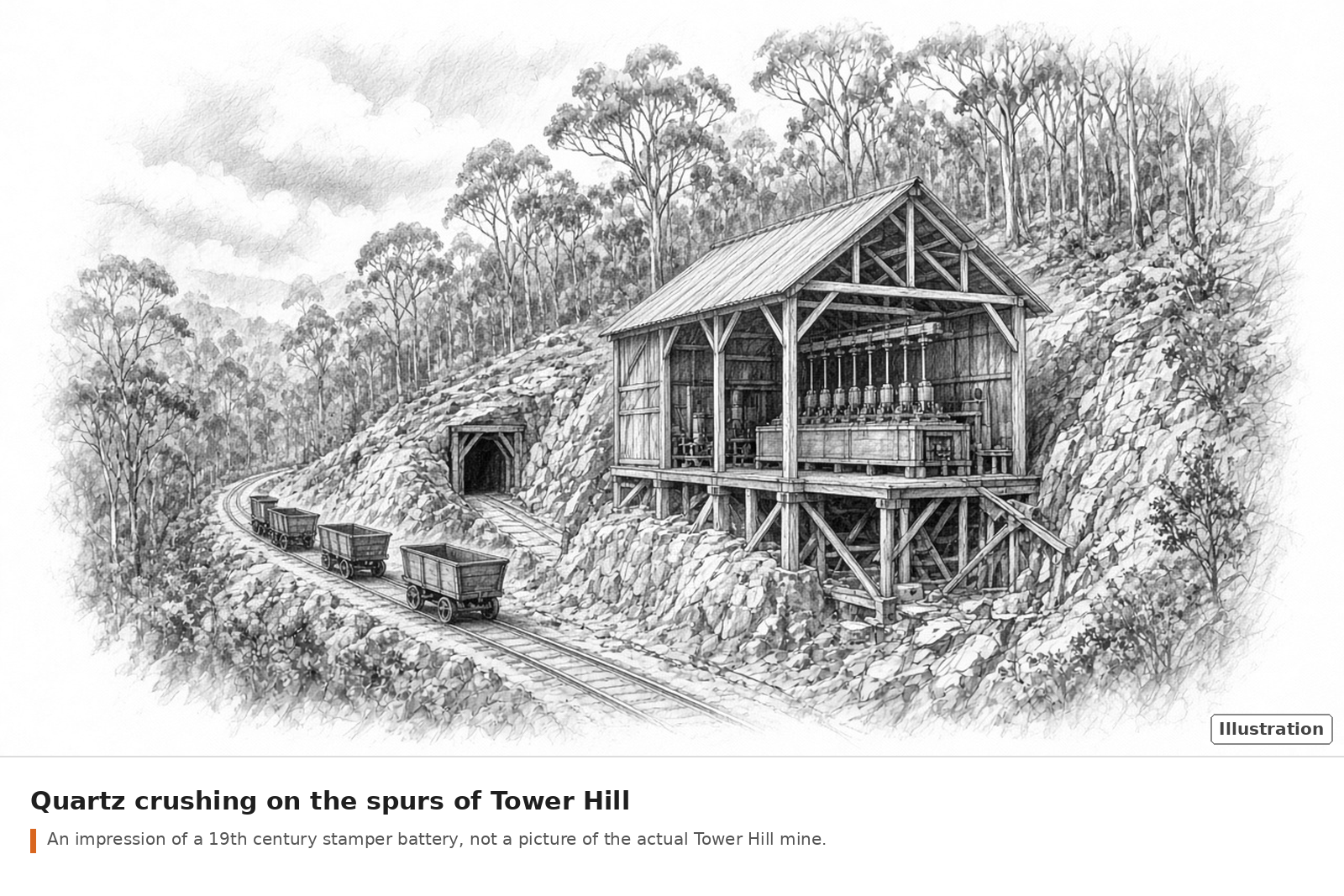
Mangana became the first of a string of goldfields along the upper South Esk. To the north, near the headwaters of the South Esk, the Golden Gate mine at Mathinna became Tasmania's second-largest gold mine. Its main working years ran from 1888 to 1932, its deepest workings reached about 580 metres, and the field produced more than 7 tonnes of gold (UTAS Companion to Tasmanian History).
Tower Hill rises above this country. Its summit, East Tower, stands at 1,118 metres and is made of hard quartzite, not granite.
Sources: Mineral Resources Tasmania; UTAS Companion to Tasmanian History; Placenames Tasmania and theLIST.
Safety first: old workings
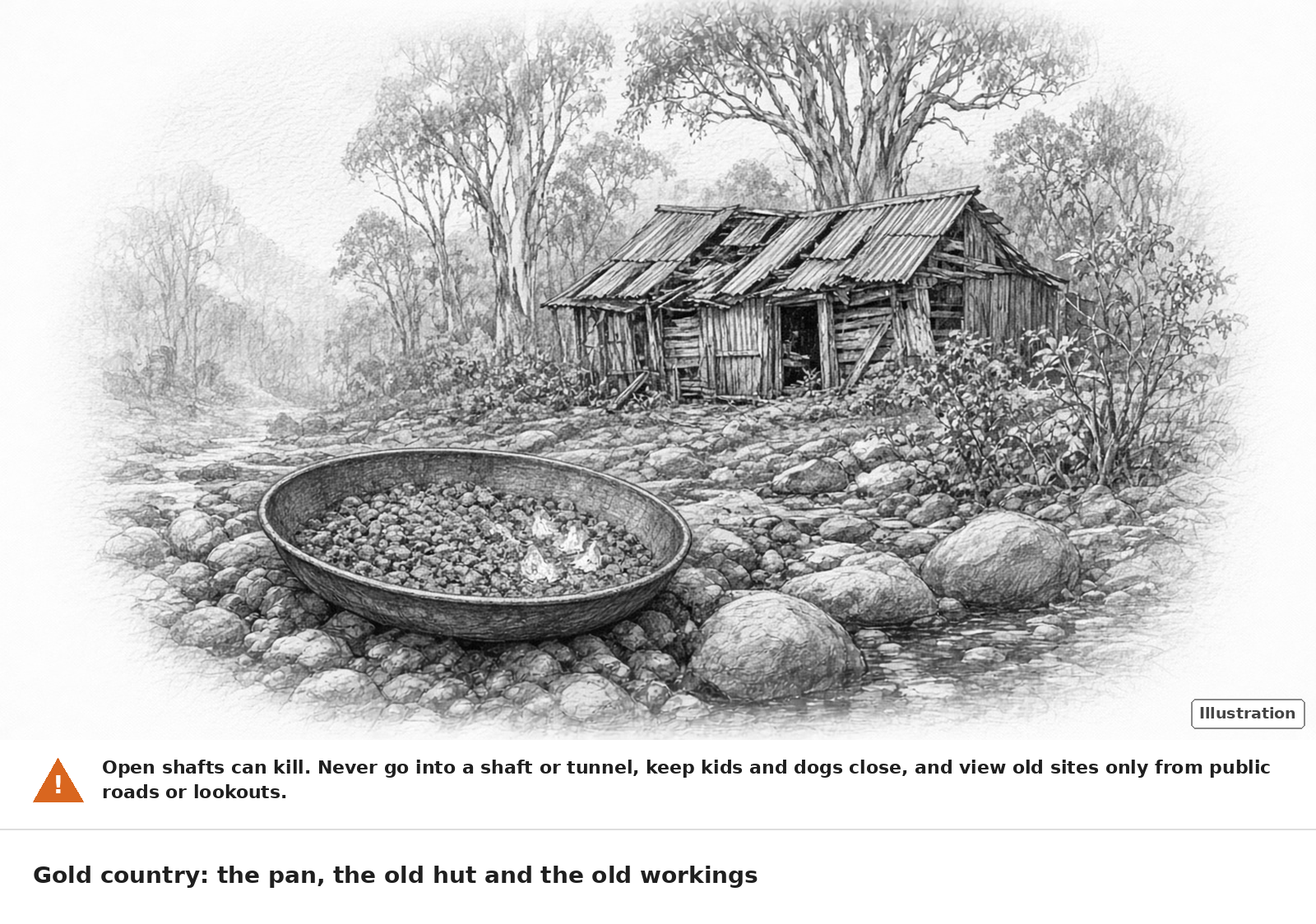
Open shafts can kill. Old shafts and tunnels in this country can be unfenced, overgrown or hidden under rotten covers.
Ground near old workings can collapse without warning, and bad air collects underground.
Keep out. Never enter a shaft or tunnel, keep to tracks, and keep kids and dogs close.
Snakes. All three Tasmanian land snakes are venomous and most active from December to March. Wear boots and long pants. If bitten, keep still, apply a pressure immobilisation bandage and call 000.
Creeks can rise quickly after heavy rain, and weather changes fast. Check TasALERT and fire bans before you go.
Mobile coverage is patchy. Tell someone your plan and when you'll be back, and carry water and a charged phone.
Pairs with camping
Camp with us at Tower Hill and use the farm as a base for exploring the goldfields. Book your stay